All posts by Quentin Budworth

Quentin Budworth is a hurdy-gurdy virtuoso, composer, and award-winning filmmaker, blending European folk traditions with drone music, while cycling the Highlands, indulging in cheese, and leading bands Celtarabia and Agent Starling. Author: The Secret Life of the Hurdy-Gurdy - Field Notes On Playing https://quentinbudworthmusic.com/book/

Meeting up with Peter Kanssen in London

It was really great to meet up with Peter Kanssen yesterday and have a good play through some tunes and have a delicious Parsnip Soup lunch (not pictured). I also got the chance to have a go on Peter’s Neil Brook 3d Gurdy (storming!) and his amazing Sam Palmer midi gurdy both of which I have to say are lovely instruments. As a few people have been in touch about my thoughts on Sam’s midi gurdy I’ll write a post about it in the not to distant future.

One thing that came up during the meeting was the variable length crank as a learning tool …. to develop articulation of the coups – (buzzes) of the Hurdy-Gurdy trompette.

May Day South London with Fowler’s Troup

Hurdy Gurdy Player and good friend Peter Kanssen asked if I’d be up for a day of playing music with him as part of the May Day Celebrations. I jumped at the chance. The Fowlers Troop Jack in the Green was revived by members of Blackheath Morris Men and friends in the early 1980s. It is a revival of a Jack in the Green from about 1906 which was taken out around Deptford, South East London on May Day by the original Fowlers Troop. Here are some pictures of the proceedings. More information about the event and the Jack-in-the Green can be found here https://www.deptford-jack.org.uk’


12 Jacks have been sighted so far this year.

They are:

  • The Oxford Jack-in-the-Green
  • The Fowlers Troop (Deptford) Jack-in-the-Green
  • The Hammersmith Jack-in-the-Green
  • The Dead Horse Morris (Whitstable) Jack-in-the-Green
  • The Bovey Tracey (Grimspound Morris) Jack-in-the-Green
  • The Bluebell Hill (Rochester Sweeps) Jack-in-the-Green
  • The Bristol Jack-in-the-Green
  • The Hastings Traditional Jack-in-the-Green
  • The Whitstable Jack-in-the-Green
  • The Guildford Bush
  • The Evercreech Jack in the Green
  • The Ilfracombe Jack-in-the-Green

I’m still waiting for confirmation that the following Jacks have been sighted:

  • The Winchcombe Jack-in-the-Green
  • The Highworth Jack-in-the-Green
  • The Knutsford Jack-in-the-Green
  • The Isehara (Japan) Jack-in-the-Green
  • The Hever Castle Jack-in-the-Green

Scandimoot

scandimootwebsitebanner2

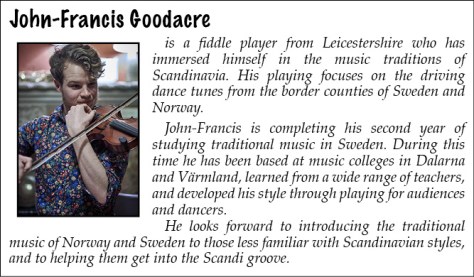
Well – what can I say Scandinavian music is unique and presents a challenge to the Hurdy-Gurdy however I was fortunate to receive some excellent tuition from fiddler John Francis Goodacre in the style and approach to playing the tunes. Having never played any Scandinavian folk music before I’m really glad that I joined the beginners class as there was really a lot to learn in terms of rhythm and ornamentation.

3ca03ba9-c60b-4136-a663-41badfee8af7

Scandimoot is held in Clapham in the Yorkshire Dales National Park annually on the May Bank holiday. It’s abeautiful place.

Researching Hurdy Gurdy Playing at Cecil Sharp House

Yesterday I went to the fabulous The Vaughan Williams Memorial Library (VWML) England’s national folk music and dance archive, an essential resource for anybody interested in the folk arts.

The English Folk Dance and Song Society (EFDSS) is the library’s custodian. The Library is housed at the Society’s HQ, Cecil Sharp House in London. Here’s the link https://www.cecilsharphouse.org/library-and-archive

Many thanks to librarians Laura Smyth and Martin Nail for their help.

Benoit Roblin Hurdy Gurdy Workshop at the Winter School

Benoît Roblin has grown to the sound of the hurdy-gurdy at Vierzon in Berry. Formed by Laurent Bitaud then Alexis Vacher, Benoît obtains his DEM in traditional music in 2008 then embarks on the professional adventure accompanied by his old green wheel designed by Jean-Paul Dinota.

Benoît Roblin has developed his own game, inspired by viellists of different styles, working on energy and groove. He has always put traditional music to dance in the heart of his instrumental practice, those of Berry mainly with Decibal, the big trio,  the  Hervé duo  and now in solo ball  , through Poitou with  Son de bouc,  the  Roblin duo. Pacher,  the  duo Jagueneau-Roblin and Tord Boyaux,  Brittany and Vendée in the  Roblin-Evain-Badeau Trio,  and Gascony with Nòu.

Projects full head and fingers, Benedict continues to create over the meetings, always looking for new experiences.

Benoit Roblin : hurdy-gurdy, feet, singing.


Far From the Madding Crowd – eMade Kinnersley Castle – Music for dancing – Far From The Madding Crowd – Peak Dance

This was a really lovely full on learning experience as participants we were offered a very full programme of learning experiences with the opportunity to dance in the evening. APR2019 Workshop Timetable . I learnt about playing and singing for dancing in Breton, Poitou and Scandinavian folk music over four days. To say that the experience was intense would be an understatement – I learnt a lot about playing styles, singing, call and refrain, playing by ear and much more.

My Mousnier Tenor Hurdy Gurdy which had it’s first outing on this trip. It was a challenge using a new instrument in a workshop situation however people seem to really like it’s low sound and roar.

For more inf visit http://peakdance.org.uk

Master Class with German Diaz at the Spielkurs Mühlhausen

Course 5: Advanced hurdy gurdy g/c
Germán Díaz

The advanced course with Germán Díaz  focussed mainly on melodies and rhythms of the Iberian peninsula, which Germán can convey authentically firsthand: It is always about the transfer of what has been learned to one’s own music, ie the question of how the techniques can also be used in traditional European dance music. In addition to universally applicable techniques, Spanish melodies and a considerable portion of concentrated musicality, you will also receive rhythmic inputs for quaters, fives and six-shots.

Another part of the work will deal with approaches and techniques for modal improvisation on traditional music, which are universally applicable in the field of traditional music and demand in addition to your understanding of music and your technical skills.

Master Class with Elizabeth Pignol at the Stichting Draailier En Doedelzak weekend.

Hurdy-gurdy for (more)advanced players – Isabelle Pignol (Fr)

This workshop for more advanced players. This course will focus on the musical and technical aspects of hurdy gurdy playing, including dynamics, phrasing, ornamentation, and right and left-hand articulation (both with and without trompette). Isabelle’s interesting techniques will most surely give advanced players something to study this weekend! She writes us she likes to work this weekend on:
games and practices in the group to study on the posture and the position of the instrument, to improve the listening and the sound
– «loose handle strike», loose and half loose wrist strike, binary, ternary and assymetrical. Working method for 6 and 6-loose beat strikes
– Searching for the double intonation of the chien to improve the «swing».
– Effect of rhytmical and melodical styles: combinations, off beat, syncopation, appoggiatures, mordent, vibrato, portamento, détaché, pizzicato.
– How to be rhytmically free
– Working on harmony: arpeggio’s of chords
– Çreations: two-part writing, improvisation, composition.
– Examination of ‘sounds’
– Examination of style and interpretation
– Traditional and modern repetoire, individual pieces and polyfony

Listen to the music of Isabelle Pignol:
• Isabelle Pignol – cinquième saison
• Tri-Bal – Asie you want
• Tri-Bal – Rond d’eau douce
• Tri-Bal soundcloud pagina
• DEDALE – live in park Chateau St Chartier (1993)
• Ritmythes – Duo vielle – batterie (oude opname)
• Ritmythes – Vent de sable (oude opname)
• Tribal – documentaire

Here are some pictures from this wonderful event

Winter School at Gaunts House

I attended music workshops at the Gaunts House Winter School over 4 days with Benoit Roblin, Gilles Chabenat, Julien Barbances and Lyset i Forsen the groups were very small and this made the learning process very quick and in depth. I also learnt to dance Scottische, waltz and Mazurka (thank you Jean for your remarkable patience). The Winter School is a nine day event which brought  professional musicians, singers and dancers from all over Europe to provide a very rich and exciting program of dance and music workshops, concerts and bals. More info about the Emade organisation who put on the event can be found here http://www.emade.org.uk/winterschool.php the full programme is here programme winter school Gaunts House


I’ll provide details of the specific workshops and learnings in subsequent posts.

So far Hot GriseldaEelgrindersTondo (Gilles Chabenat, Maarten Decombel, Fred Pouget), Ciac BoumHRDLyset i forsentrio Roblin/Evain/BadeauNaragonia Benoit GuerbignyJulien BarbancesRémi GeffroyGabriel Lenoir have confirmed their coming.

Dance workshop teachers include : Leif & Margareta Virtanen (Swedish dances), Anne-Cécile Dubois (tango and more), Maria Guerbigny (Lindy hop), Mike &Heidi Gibbs (rueda), Gabriel Lenoir (Dances from Wallony) & more (polska, Poitou, Bretagne, French mazurka…

The Folk Ball events and concerts were fantastic seeing  top European Folk Musicians play in  a dance context was invaluable. Dancing to the tunes they played a profound and deep level physical understanding of the function and dynamics of the music – magic!


Halsway Manor Hurdy Gurdy Weekend 2019

I attended the Halsway Manor Hurdy Gurdy annd Bagpipe weekend it was amazing. I studied with Francesco Giusta. What did I learn… lots here is a video demo of the music from the workshop.

Ways into playing 2 time bourees – three part harmony arrangements for Hurdy Gurdy also approaches to playing Waltz and Mazurka – variable speed wheel technique slow cranking to give space and rhythmic spice too tunes, off beats paradidles and a whole lot more.

Here is a full list of tutors for the weekend:
The Team (Hurdy Gurdy)
Claire Dugué (Host) a native of France, encountered the hurdy-gurdy in London during her college training as an instrument maker. She was captivated by the instrument and has been making hurdy-gurdies ever since, producing quality instrument for amateur and professionals alike. Claire has now taken over the organisation of the weekend from Paul James and will be hosting the event and be also at hand to help with the technical aspects of setup and maintenance.

Gilles Chabenat is regarded as one of the very best hurdy-gurdy players of his generation. He began playing the hurdy-gurdy at 13 with Les Thiaulins, an association devoted to folk arts and traditions. Following private lessons with Georges Simon, he won several music awards and subsequently devoted himself to his region’s traditional repertoire with a desire to branch out into other musical styles.

In the wake of Valentin Clastrier, he thus felt the need to reinvent the instrument and the playing techniques associated with it. Around that time and after several years of research, luthier Denis Siorat developed a contemporary-style electro-acoustic instrument which facilitated the integration of the hurdy-gurdy into the modern musical experience.

In 1992, Gilles Chabenat began a twelve-year partnership with the Corsican group I Muvrini. During that period, he met and worked with a number of renowned artists: Véronique Sanson, Stephan Eicher, Jean-Jacques Goldman, Sting, as well as Frédéric Paris, Edouard Papazian, Alain Bonnin, and Gabriel Yacoub to name but a few. More recently, he has been collaborating with jazz musicians and also works regularly with Eric Montbel, Didier François, a Nyckelharpa player, Gabriel Yacoub and Patrick Bouffard.

Gilles’ musical experience and evolution are thus constantly shaped by the people he meets. In his approach to hurdy-gurdy playing, he draws essentially on the multifaceted nature of an instrument which has been in constant evolution for more than one thousand years.

Francesco Giusta (Italy) started to play hurdy gurdy at the age of 11 with local tutors before developing his technique with some masters of the instrument; J F Maxou Heintzen, P Bouffard, G Jolivet, G Diaz, T Nouant, S Durand and V Clastrier.

Within the years he has played in several bands, mostly in folk and medieval music performing at many folk and medieval festivals in Italy and France; worked with Lou Dalfin and in some musical project with Sergio Berardo.

He recorded some CD’s (‘En l’aire ailamont’ in 2011 and ‘Podre’ in 2013 with La Mesquia, ‘Balfolk’ in 2014 with Trigomigo) and was a guest in ‘Bon Nadal Occitania’ in 2009, with Sergio Berardo, ‘Cavalier Faidit’ in 2011 with Lou Dalfin, ‘Santulubbiranti’ in 2015 with Malanova.

Since 2011 he has been giving masterclasses in Germany and regular lessons in Turin. In 2015 he won the first price at the hurdygurdy challenge at ‘Le son continue’ festival in Chateaux d’Ars, France.

He now plays with Trigomigo, Controcanto, Bal là and has regular hurdygurdy classes in Turin and Cuneo.

Joel Turk is one of our regulars at Halsway Manor, as he has been teaching hurdy-gurdy to the most advanced players over the past 2 years. He is back this year to look after the beginners! Joel is well known for being a member of the great band Red Dog Green Dog.

Two really useful videos on modes and tonal centres

Knowing how to create modes from the major scale is a really useful skill here’s how to do it.

If you think about the tonal centre of the Hurdy-Gurdy as the drone string then changing it’s pitch can open up lots of interesting possibilities…using the same melody…

Brexit

Due to the uncertain political situation and the danger of crashing out of the EU with ‘No deal’ I’m having to do some research into factors affecting artists travelling in Europe the Arts Council have published some guidelines for arts organisations here:

ACE_EU_Exit_Guide_22jan19

Also with regards to travelling in my car I’ll need a special permit called an IDP (International Driving Permit) in the event of a ‘no deal’ Brexit, IDPs may be required for people intending to drive in EU countries after 28th March 2019.

Post Offices offering the IDP service can provide information on IDP requirements before 28th March 2019, or you can visit www.gov.uk/driving-abroad/international-driving-permit

Crikey it’s all happening! The Euro is really high – as I found out today when booking onto workshops in Germay and Holland. I’ll have to double check my health and travel insurances too… also my medical card is still valid.

I got the blues on the Hurdy-gurdy

Inspired by the Muddy-gurdy film and remembering a deep teenage of love of the blues I’ve been doing some online and action research into playing the blues and blues improvisation and started to work on how to make it work on the Hurdy-gurdy.

I’ve looked at guitar blues methodology here:

https://www.musicradar.com/tuition/guitars/8-essential-blues-guitar-lead-tricks-640018

https://www.musicradar.com/tuition/guitars/25-blues-rock-guitar-licks-you-need-to-know-636061

I’ve looked at violin methodology here:


The structure of the music the 8/12/16 bars would lend themselves to looping and then soloing over the top… Remember if the tune if the tune is in D solo and improvise in D likewise G and C.

blues-chord-progression-1
images (1)

In D:
I = D IV=G V=A
IN G:
I = G   IV= C V=DIN G:
In C
I = C   IV= F V=G

Blues Scales in Gurdy friendly keys:

The blues scale in D is: D F G Ab A C

The Blues Scale in G is: G Bb C Db D F

The Blues Scale in C is: C Eb F Gb G Bb


Major Pentatonic Scales in Gurdy friendly keys:

Pentatonic Major in D: D E F# A B

Pentatonic Major in G: G A B D E

Pentatonic Major in C: C D E G A


Minor Pentatonic Scales in Gurdy friendly keys:

Pentatonic Minor in D:  D F G A C

Pentatonic Major in G: G Bb C D F

Pentatonic Major in C: C Eb F G Bb