The winter solstice brings a unique rhythm to a musician’s life. As the days grow shorter and the fire crackles, we are often gifted that rare commodity: time. Time to unwind, time to reflect, and most importantly, time to reconnect with our instruments.
If you are a hurdy-gurdy player—whether you are just finding your “sea legs” with the crank or you are a seasoned veteran—this holiday season offers the perfect opportunity for a technical and creative “tune-up.” But we aren’t just talking about applying fresh cotton or tightening the trompette. We are talking about a tune-up for your musical mind.
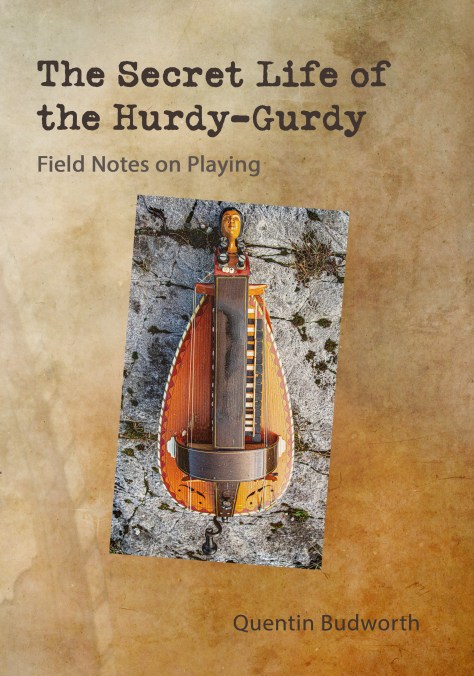
This year, true hurdy-gurdy Christmas inspiration comes in the form of a resource that feels less like a textbook and more like a late-night gathering of the world’s best players. It is called “The Secret Life of the Hurdy-Gurdy: Field Notes On Playing” by Quentin Budworth.
If you are looking for an expert hurdy-gurdy book to guide your winter practice, here is why this collection of field notes belongs on your music stand.
The Antidote to Musical Isolation
Let’s be honest: the hurdy-gurdy can be a solitary path. Unless you live in specific pockets of Central France, Northern Spain, or Hungary, you might be the only player in your town. The isolation can lead to a plateau in skills, where we stop challenging our own techniques.
Budworth’s book addresses this head-on. It acts as a bridge to the wider community, compiling the distilled knowledge, pedagogy, and personal theories of 32 renowned players from across the globe.
We are talking about insights from heavyweights like Matthias Loibner, Patrick Bouffard, Michalina Malisz, German Diaz, and Steve Tyler. Instead of one teacher’s rigid dogma, you get a kaleidoscope of perspectives. It covers everything from the physics of the wheel to the social context of being a drone musician in the 21st century.
Theory, Pedagogy, and “The Secret Life”
What makes this book unique is that it doesn’t just give you sheet music; it teaches you how to think like a player. Here is how it adds depth to your practice:
Rethinking the Drone: One of the recurring themes in the “Field Notes” is the relationship between the player and the drone. The book explores how different experts visualize their sound—some see it as a vocal line, others as a rhythmic engine. It challenges you to stop “cranking a handle” and start “bowing a continuous circle.”
Pedagogy for the Self-Taught: Since so many of us are autodidacts, we often miss the “how” of learning. The book offers specific strategies on how to structure practice, how to listen to your own playing, and how to overcome technical walls.
Social Context: Budworth includes fascinating chapters on where the instrument fits in society. It connects the modern player to a lineage of beggars, courtiers, and avant-garde performers, helping you understand the weight and history of the instrument in your lap.
A Guide for Your Holiday Practice Sessions
As you plan your holiday downtime, you can use “The Secret Life of the Hurdy-Gurdy” to structure a practice regimen that breaks old habits.
1. The “Sound Design” Session: Use the expert interviews to focus purely on tone. Spend a session adjusting your pressure and speed based on the descriptions in the book. Can you achieve the vocal quality described by the masters?
2. The “Rhythmic Reset”: Dive into the sections on the coup de poignet (wrist stroke). The book reveals how different cultures approach rhythm—from the strict dance beats of the Bourbonnais to the fluid styles of contemporary folk. Use the holidays to deconstruct your rhythm and rebuild it with greater intent.
An Ethical Gift: Buying Direct from the Artist
In an era of generic online shopping, there is something grounding about purchasing independent art directly from the source. Quentin Budworth is a champion of the independent creative spirit. In a move that aligns perfectly with the folk tradition, he has made the book available directly to the community.
There is no corporate markup here. When you buy this book, your money goes to the researcher and artist who created it.
The Investment:
USA: $35
UK: £24.99
Europe: €35
(Shipping is calculated upon inquiry based on your location).
How to Order Your Copy
To secure a copy for yourself or as a thoughtful gift for a loved one, the process is personal and simple:
Include your postal address and the number of copies you wish to purchase.
Await the reply: Quentin will respond with the total cost including shipping and payment details (typically PayPal or Bank Transfer).
Final Thoughts
This Christmas, don’t just practice your mistakes. Practice with purpose. Let the collective wisdom of 32 masters guide your hand. “The Secret Life of the Hurdy-Gurdy” is more than a book; it is a mentorship in paperback form.
Grab a copy, pour a glass of something warm, and let’s get that wheel spinning.
Throughout this autumn I have been working on the Disconnect-Reconnect Show developing ideas and researching approaches to the project. From Nov 1st to 7th I was on a residency at Cecil Sharp House on a residency to develop my ideas further.
1. What did you use the bursary funding for?
I used the bursary funding to develop, refine, research and explore ideas for my new solo show Disconnect/Reconnect. I’ve been researching and developing a cross genre show in which story-telling, theatre and music are combined with new writing, digital media to create a unique folk gig that weaves immersive storytelling with live music inspired by music from the pan European and England’s traditional music repertoires using contemporary approaches to create a show that has broad popular appeal. In financial terms I used the bursary to pay my expenses and wages whilst I worked on developing the Disconnect/Reconnect project at home and at Cecil Sharp House in London. I’ve invested some of the money on joining the Monday Singers at EFDSS to develop my singing.
2. Would you have been able to do this work if you did not have the bursary?
There is no way I would have been able to dedicate the concentrated effort, thought and experimentation on this project if the bursary had not been awarded.
As a full-time musician and artist my income is really quite low compared to the average wage so opportunities to travel and spend time in London researching ideas, new musical and performance concepts are relatively rare as the cost of accommodation, travel to from and around London are prohibitive.
Being on residency gave me a strong credible platform to conduct crowd-based research via social media. The ability to ask pertinent and impertinent questions yielded some great new ideas whilst confirming and challenging some deeply held personal beliefs.
The residency enabled me to broker relationships with potential participants for the project both in the UK, Europe and America.
Being able to discuss the ideas in the project with Nick and Malcolm in the library and their miraculous ability to pull out fascinating resources that moved my thinking along was a joy.
I think one of the reasons I wanted to come to London was to meet and have conversations with staff at Cecil Sharp House to develop the ideas in the show. However remote working due to the coronavirus made this impossible. It would have been inspiring to have heard some stories about previous residencies and work developed as a result of them.
I used some of the money to pay for the EFDSS Monday Singers sessions with Emily Portman. This has been great fun and a tremendous learning experience, challenging me consistently to develop my skills as a singer and develop and learn new repertory. Work I will continue to focus on over the next year as the show develops.
One of the intangible but valuable benefits of the residency is that I feel much more confident about the project and my own abilities as an artist and validated by the Alan James Creative Bursary Award as a musician. I know previous awardees have gone on to create wonderful things based on their research and I hope Disconnect-Reconnect will have a similar impact.
3. What future plans do you have to use and/or develop the work created?
I’ll be developing the work into a show and album that I hope to tour in autumn 2022
I’ll be working with my musical collaborators closely to develop and refine their musical contributions to the show.
I’ll be writing more new tunes that respond to and develop the tunes shared with me.
I’ll be looking for additional funding to produce, rehearse and tour the show using Arts Council Project Funding Awards.
Using the insights, I gained on residency I will be developing the show further and challenging myself in new ways as a performer. By developing singing skills, mouth music skills and foot percussion skills.
I’ll be actively seeking out and developing my skills as a story-teller and raconteur. I’m hoping to spend some time with Taffy Thomas.
4. Any other things you would like to say or like us to know?
The show I’ve been working on whilst I’ve been here at Cecil sharp house is a solo show called ‘Disconnect-Reconnect’. It’s about how music allows us to cross borders without inhibition and connect people even when we’re really isolated. Underlying that it’s about creating and listening to music as a shared social experience.
The show involves storytelling digital media and of course tunes on the hurdy gurdy. It’s designed to be a lot of fun with plenty of laughs and heart. There will be guest appearance by a number of musicians via video so that I can take all my friends on tour with me and navigate and share my musical world in an augmented concert experience using projections.
One thing that’s been particularly interesting while I’ve been here on residency, and caused me a lot of fascination is the archive resources and the library, which are just tremendous. I’d like to say a big thank you to Nick and Malcolm for finding and searching out some really great materials. Of particular interest are the photos from the pre-war international folk dance and song festival held in 1935 a few years before the start of the second world war which give us an extraordinary glimpse into another world whilst provoking deeper questions around national Identity and state.
The images from the 1935 Festival are a delight and I’m sure I will find a way of incorporating them into the final show.
Special thanks to Nick for introducing me to some new ways of thinking and understandings in this area.
I’ve also been using my time during the residency to engage in discussions with other musicians and artists around the country and indeed across Europe to find out what their feelings are on things like Brexit, the impact of COVID and the social nature and intangible benefits of playing music together and for audiences that go beyond the simple metric of ticket sales. I’ve been looking at like the spiritual emotional, and social dimension of making music together. So that’s been really interesting.
Here are some of the questions I asked on social media: 1.
It’s day one of my Alan James Creative Artist residency at Cecil Sharp House and I’m starting with a question to musicians in the UK. In one word (or more) describe your feelings about Brexit.
2.
It’s day two of my Alan James Creative Artist residency at Cecil Sharp House and I have another question to musicians in the UK.
‘Brexit has proved to be hugely divisive. What can we as musicians do to build bridges with Europe and re-establish cohesion within our own society?’
3.
It’s day three of my Alan James Creative Artist residency at Cecil Sharp House and I have another question to musicians in the UK.
‘The impact of the Covid pandemic and Brexit has been tremendously isolating for us all, what stories do you have of overcoming isolation and creating connection with other musicians and audiences during these challenging times?’
4.
It’s day four of my Alan James Creative Artist residency at Cecil Sharp House and I have another question to musicians in the UK.
‘What does the new normal look and sound like for you as a musician? What has changed, what has stayed the same, what is better, what is worse?’
5.
It’s day five of my Alan James Creative Artist residency at Cecil Sharp House and I have another question to musicians in the UK.
‘Playing together has a spiritual, social and emotional value beyond the economic drivers of ticket and album sales. How do you use music connect to others and what are the ‘intangible’ benefits you find in the act of making and sharing music?’
Participants took part in the discussions in quite large numbers and the answers given were thoughtful, funny and had heart-warming qualities I’d like to bring to the show. The answers to question five were particular insightful moving beyond anger to hope a central theme of the Disconnect-Reconnect show.
Here are some of them:
Music played with others, is a form of Esperanto; a second language, whereby you might communicate with others, where you may not have a common tongue. Chris Tandy
It’s non-verbal communication. That’s a pretty amazing thing. I can’t put a specific value on it, but I know my live would be very dull without it. Jane Bird
I met a very high proportion of my friends through music, some of which I’ve never physically met, but music provides a real connection between us. Making music with others ranks as one of the greatest pleasures in my life, it’s been like that since I started making music 58 years ago.
Plus, another of life’s greatest pleasures is seeing the emotions that you can bring out in the audience – happy, sad, remembering. Music has the power to make connections in so many ways.
For example, years ago I was busking in York City Centre. I was playing Whistling Rufus on my melodeon, when an elderly lady stopped, listened, and started crying. When I finished the tune, she came over, grasped my hands, and thanked me. It had been her late husband’s favorite tune. Remembering that musical moment still moves me Kevin Holland
I am just heading out for a week-long Pagan retreat where we will connect with each other through instrumental music, chant, song, mantras, drumming etc. I could go on for pages and pages as music is integral to our Ritual and social interaction and is and social interaction and is also woven through our everyday interactions. It encompasses both solitary and group spiritual practices. And is used in many other ways that I am not sure I should share here. Blessings. David Manley
The above, yes, especially Chris Tandy’s comment at the top. Playing for people to dance, whether or not we have many words in common, can be a deep, almost spiritual experience. Playing in public when a tiny toddler starts dancing along, and watchers share the joy is pretty good, too. Richard York
Where playing with others becomes a communication of harmony, counter melody it’s an amazing level of communication. To know where they might go with the impro. It forms a relationship. Watching dancers physically respond to that key or tempo change is pretty amazing too. Janet Worrell
Worked abroad for four years and could settle, make friends and absorb local culture because I found local musicians playing local music, who shared music with me. Also met other folk musicians who were travelling and shared music. Wouldn’t have been happy without music then – might not have been able to cope. Jo Drew
Part of my work has involved liaising, gathering in and playing along to the videos from my fellow musicians and projecting them and then working out and researching the logistics for how to back project and projection map elements of the show. As this will make for a much more interesting live experience for the audience.
One of the unexpected consequences of the residency is that something of the spirit of Cecil Sharp house has influenced my thinking and allowed me to take my ideas forward and provide really stimulating areas for further research. Being able to embark on one line of inquiry in the library, and then come across something else that’s really quite fascinating and takes you off on another tangent has been excellent.
So, it is the library I have to thank for developing my interest and being able to satisfy my curiosity about Puirt-a-Beul music, and mouth music making in England for dancing. Listening to the wax cylinder and field recordings at the listening post in the library was a direct window onto another world and something I will treasure for a very long time.
There is an element of my research that is definitely going into the show, which is the seated step dancing whilst doing mouth music whilst playing the rhythm with your feet. Having read the description in one of the journals about this it’s just I have to do this this is really good useful inspiring knowledge.
One of the joys of being at Cecil sharp house on residency has been have access to these wonderful rehearsal rooms, and to just be able to sit in them and play and to think and to reflect and to develop ideas, having the space and the time set aside to just do this one thing without the distractions of normal life has been lovely. One of the unexpected outcomes of this is that I’ve written a couple of tunes for the project. I really wouldn’t have gotten around to doing had it not being a residency so that half hour 45 minutes in the morning, just practising warming up and playing around with ideas, has had some really lovely outcomes.
As an artist, it’s a rare privilege to be given the opportunity to have a residency to develop new creative ideas and I’d like to say a really big thank you to Cecil Sharp House the EFDSS and to the Alan James Creative Bursary fund for allowing me the opportunity to explore and develop new ideas and create new work. It’s been fantastic.
Sitting and writing the evaluation and having a chance to reflect on the residency has been a particularly useful exercise as it has allowed me to draw together many of the learnings, reflections and most importantly the key next steps for the project.
It’s a big heartfelt thank you from me.
Quentin Budworth Musician and Artist.
Meet Quentin Budworth, a musician living on Skye He is a multi-instrumentalist, a highly skilled performer and composer, specialising in the hurdy-gurdy.


 Quentin Budworth Musician