
COMMON & TRADITIONAL ORNAMENTS – trills including trill-from-down and mordents – unison including “norwegian trill” aka unison+trill – drones (tune : ‘Herr Olóf’ from Sweden) – changing drone on a scale aka simple double-stops (mostly Värmlands polska & Røros pols) – dajstråk (tune : ‘Flödens död’ polska efter August Bohlin) MODERN & “COOL” ORNAMENTS – slide (up or down) – chop (tune : Halling etter Hilmar Alexandersen) (check the masters : Casey Driessen, Darol Anger, Rushad Eggleston) SELDOM OR SPECIFIC ORNAMENTS – long trills (mostly in Siljan region in Dalarna, Sweden) – rolls – vibrato
All posts by Quentin Budworth
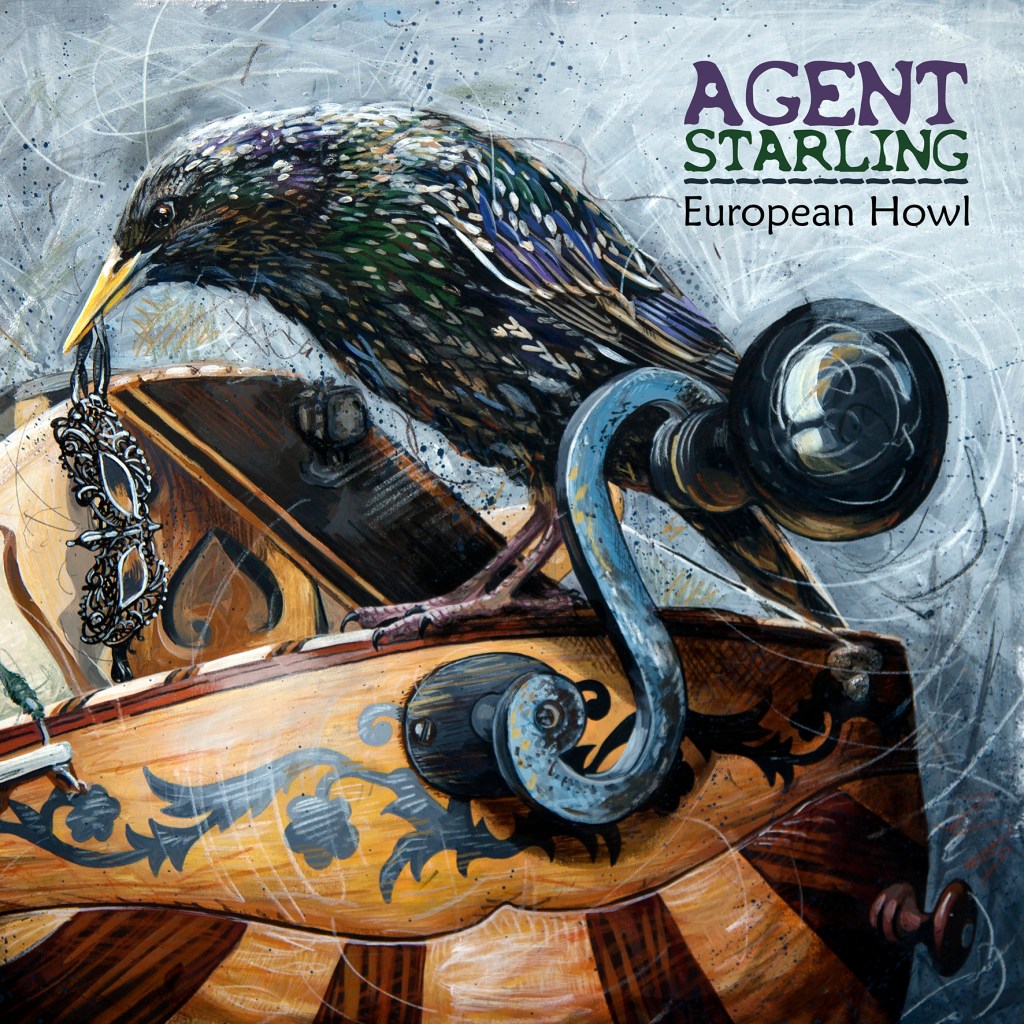
Agent Starling New release
DHM RECORD LABEL RADIO PRESS RELEASE For immediate release
Agent Starling release European Howl
Agent Starling’s debut album, European Howl releases on all the usual digital outlets on May 4th, 2021. The ten-track album is full of catchy hurdy-gurdy tunes, new songs, hypnotic drones, live bass grooves & strings, all with an experimental edge.
Agent Starling are Quentin Budworth hurdy-gurdy and Lou Loudhailer voices & other instruments. Recorded in the first three months of 2021, European Howl also features Dexter Duffy-Howard on violin and cello. Recorded in Yorkshire UK by Agent Starling, the album was mastered in Oregon by Kevin Carafa.
The album is influenced by musical traditions from nations across Europe. A mix of instrumental pieces, spoken word and songs, themes range from a miscellany of Greek Tales (Wine Dark Sea), an elegy by a dying lover (Requiem) to Helicopter Arms, inspired by the glorious gurdy tune at the heart of the song. Delores County Ride is a tribute to the women who hop trains in Arno Bitschy’s film This Train I Ride, and the album’s title track is an ode to being European, a call for connection in today’s isolationist climate.
Quentin and Lou both have strong musical provenance. Lou was originally in prophetic UK Indie band Red Guitars and has gigged and recorded ever since, heading up psychedelic rock band Loudhailer Electric Company. Originally part of Suns of Arqa, Quentin is the force behind world fusion medieval rave band Celtarabia, also featuring Lou on bass. He spent the year before lockdown touring Europe meeting with other top hurdy-gurdy players exchanging tunes, techniques and experiences. The band usually play the alternative festival circuit throughout the summer, but due to lockdown restrictions on live music, Lou and Quentin joined forces to create Agent Starling and record European Howl.
European Howl releases on all the usual digital outlets on May 4th, 2021 on the DHM record label, catalogue number DHM028, distributed by Label Worx.
Pre-release available from Bandcamp now: https://loudhaileruk.bandcamp.com/album/european-howl
You can see videos of the album preview tracks here: Agent Starling Video Playlist
Agent Starling contact info:
Website: https://agentstarlinguk.wordpress.com/
Facebook: https://www.facebook.com/AgentStarlingUK/
Twitter: @AgentStarlingUK
Great response to Agent Starling’s preview tracks:
“This is wonderful. It has a feeling of antiquity and a feeling of something new. The music is a blast and the images are a constant wow.” Dan Kellaway (Luthier)
“Great video and what a wonderful, unusual sound.” Aine Kennedy
“Beautiful in every way. The music, the playing and the photography are all amazing.” Richard Harries
“Love this stuff soul-moving.” Kelvin Richmond
“This is wonderful. Love the fluid bass figures.” Landi Michaels
Folk Harmonies and Accompaniments
I’m a big fan of Laurel Swift here are some videos explaining accompaniment and variation in folk music and a link to her website HOME – Laurel Swift I don’t play fiddle but the interesting thing is that the ideas and techniques she uses are transferable to almost any instrument.
Let’s Create
Let’s Create, our strategy for the next ten years, we introduce four Investment Principles: Ambition & Quality; Dynamism; Environmental Responsibility; and Inclusivity & Relevance. The Investment Principles are a family, interlinked and designed to be used together, informing the development of well-run, future facing organisations and individual creative practice.SHOW LESS
Today’s reads
Make a donation to support my music making
If you enjoy what I do, please support me on Ko-fi!
https://ko-fi.com/quentinbudworthmusic

Gamakas
Técnicas de interpretación del Salterio Italiano del Siglo XVIII – Franziska Fleischanderl – Austria
A song For US – AGENT STARLING
Lovely to get this through on the Agent Starling email this morning:
‘Thank you so much for your submission to A Song for Us music map.
‘What a great song’.
Maija Handover – Sound UK – Extraordinary musical encounters
We’re helping to create a music map at https://asongforus.org/
here’s the link to our song https://asongforus.org/…/european-howl-by-agent-starling/
@sounduk2015 #ASongforUs#Agentstarling#hurdygurdy
Voice as instrument
I came across this seriously cool no cold!
Terje Isungset is one of Europe’s most accomplished and innovative percussionists. With over two decades experience in jazz and Scandinavian music he is taking these types of music far beyond their traditional boundaries, becoming more like a cross between a sound artist and a shaman. Crafting his own instruments from Norwegian natural elements such as arctic birch, granite, slate, sheep bells and even ice, he is highly recommended to those sensible to the poetry and simplicity of sounds. “Timbres” and “colours” are central in Terje Isungsets music and compositions. In the press, his work has often been described as innovative, visual, energetic, and different from any previously known concepts. Isungset has also been commissioned to compose music for Jazz Festivals, Dance Performances, Theatre, Film, etc. (40 commissed concerts) His composition efforts have also brought nine critically acclaimed solo CD`s.
Find out more here Terje Isungset | Musician & composer
Some musical notes to self
Master Class in trompette with Valentin Clastrier
To see what is possible and the fluidity of incredible trompette work watch from 2.45 rotary play of the hand combined with a long crank … very interesting!
calm in an agitated world
Genevieve Murphy
Written specifically for The Old Fruitmarket, Genevieve Murphy’s new work is inspired by how fear can materialise through not understanding someone or something. Fellow Scot and 2016 BBC Radio 2 Young Folk Award-Winner Brighde Chaimbeul features in this World Premiere on pipes and is joined by brass, woodwind and percussion from the BBC Scottish Symphony Orchestra.
Premiered on 4th May 2019 at Old Fruitmarket, Glasgow, during Tectonics Festival.
Commissioned by the BBC, performed by BBC Symphony Orchestra, Brighde Chaimbeul and Genevieve Murphy.
 Quentin Budworth Musician